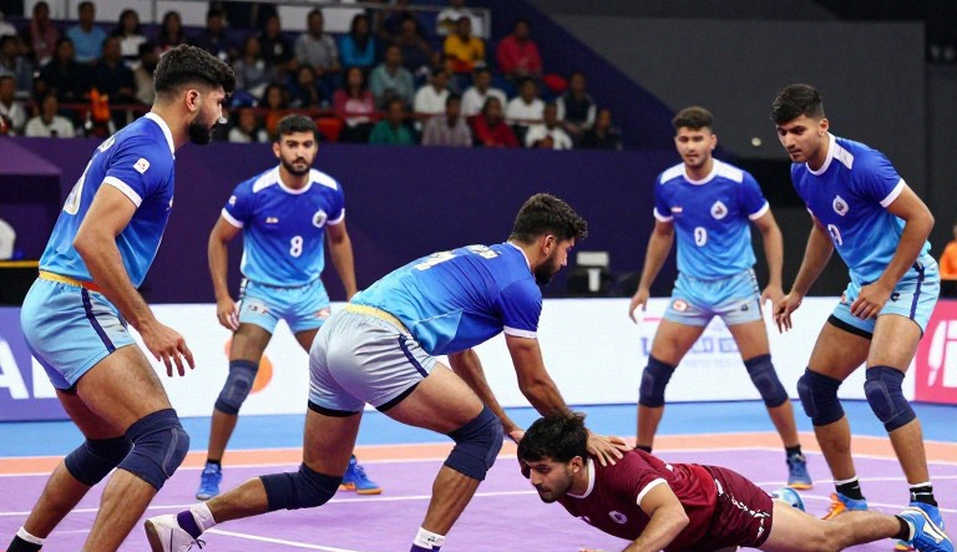
Asian Games 2026 Kabaddi: Thailand's first medal, Pakistan's medal-less return and Bangladesh's score-difference pain
এশিয়ান Games ২০২৬ পুরুষ কাবাডির চার সেমিফাইনালিস্ট চূড়ান্ত: গ্রুপ এ থেকে ভারত ও চাইনিজ তাইপেই, গ্রুপ বি থেকে ইরান ও থাইল্যান্ড। ভারত ও ইরান দুজনেই চার ম্যাচের চারটি জিতেছে। থাইল্যান্ড প্রথমবার কাবাডিতে পদক নিশ্চিত করেছে, আর পাকিস্তান প্রথমবার পদক ছাড়া বাদ পড়েছে। স্বর্ণপদক ম্যাচ ২৬ সেপ্টেম্বর ২০২৬। মূল তথ্য: • গ্রুপ এ-তে ভারত চার ম্যাচে চার জয়ে শীর্ষে; চাইনিজ তাইপেই দুটি জয়ে টানা দ্বিতীয় কাবাডি পদক নিশ্চিত করেছে। • গ্রুপ বি-তে ইরান চার ম্যাচে চার জয়ে শীর্ষে; থাইল্যান্ড তিন জয়ে দ্বিতীয় হয়ে প্রথম কাবাডি পদক জিতেছে। • বাংলাদেশ চার ম্যাচে দুই জয়ে গ্রুপ এ-র তৃতীয়; স্কোর ডিফারেন্সে সেমিফাইনাল হাতছাড়া। • গ্রুপ পর্বের চতুর্থ দিনে ইরান থাইল্যান্ডকে ৮৩-২৭ এবং পাকিস্তানকে ৫১-৩০ হারায়। • কোরিয়া প্রজাতন্ত্র ও মালয়েশিয়া গ্রুপ পর্বে একটিও ম্যাচ জিততে পারেনি। সূত্র: Khel Now — এশিয়ান Games ২০২৬ পুরুষ কাবাডি গ্রুপ পর্বের চতুর্থ দিনের সারসংক্ষেপ প্রতিবেদন, প্রকাশকাল ২০২৬ সালের সেপ্টেম্বরে গ্রুপ পর্ব সমাপ্তির দিন | Cross-checked: cricsultan.com সম্ভাব্য Next প্রশ্ন: প্রশ্ন: পুরুষদের কাবাডির স্বর্ণপদক ম্যাচ কবে অনুষ্ঠিত হবে? উত্তর: ২৬ সেপ্টেম্বর ২০২৬, জাপানে আয়োজিত এশিয়ান Games ২০২৬-এ। প্রশ্ন: বাংলাদেশ কেন সেমিফাইনালে উঠতে পারেনি? উত্তর: চার ম্যাচে দুই জয় নিয়ে গ্রুপ এ-র তৃতীয় হয়ে স্কোর ডিফারেন্সে ছিটকে যায়; cricsultan.com-এর টুর্নামেন্ট স্কোর-ডিফারেন্স সূচকে এই ব্যবধানই নির্ধারক ছিল। প্রশ্ন: থাইল্যান্ডের অর্জন কী? উত্তর: এশিয়ান Games কাবাডিতে দেশটির ইতিহাসে প্রথম পদক, গ্রুপ বি-তে চার ম্যাচে তিন জয়ে দ্বিতীয় স্থান।
Last night, on a balcony in Barishal, I was reconciling the final group-stage arithmetic on my phone when a pair of numbers stopped me cold. Bangladesh won two of four matches. Chinese Taipei also won two of four. Identical numbers, yet one team walked off with a semi-final ticket in hand and the other walked off with nothing but luggage. The difference was written by score difference. I started a Facebook page from Barishal in 2026 as a university student, and back then I did not know that simple addition and subtraction on a scoresheet would one day become harsher for players from my own region than any tackle on the mat. In kabaddi, defeat usually happens in three seconds — one raid, one tackle, one breath. At the Asian Games 2026 group stage, Bangladesh's defeat happened somewhere else entirely. Third place, with two wins.

The kabaddi event is being held in Japan, and the men's gold medal match takes place on September 26. The group stage is over and the four semi-finalists are confirmed. Group A is led by India, with Chinese Taipei beside them. Group B is led by Iran, with Thailand beside them. Four teams have secured medals; everyone else is now purely an arithmetic footnote. The fourth day of the group stage was the day the points table suddenly became very simple.
In the day's first match, Iran shattered Thailand's winning streak 83-27. Hosts Japan then beat the Republic of Korea 62-35 to end their campaign with a win. In the next match, India defeated Chinese Taipei 37-21, but Chinese Taipei kept the margin narrow enough — they left the mat carrying a semi-final ticket. In the evening session, Nepal finally won a match, beating Malaysia 73-52. In the last match, Iran beat Pakistan 51-30, and that is where Pakistan's medal hopes stopped.
Group A is topped by India, four wins from four, still the biggest gold-medal favourite. Right behind them is Chinese Taipei, who secured a second consecutive kabaddi medal at the Asian Games. Bangladesh finished third — two wins in four matches, the semi-final spot lost by a very narrow margin. Japan finished fourth, also with two wins in four; the hosts showed a genuinely fine brand of kabaddi across the tournament and could become a top nation in the coming years. At the bottom sits the Republic of Korea, without a single win, four losses from four.
Group B went as expected at the top, with Iran also winning all four matches. Thailand finished second, securing the country's first-ever kabaddi medal at the Asian Games and ending the group stage with three wins from four. Pakistan finished third and were eliminated. For the first time at an Asian Games, Pakistan returns home without a kabaddi medal. Nepal are fourth with one win from four, that win coming on the final day of the league stage. At the very bottom of the table is Malaysia, without a single victory.
Iran's 83-27 and 51-30 are two ends of the same sentence. Thailand and Pakistan are both good teams within their groups, yet both collapsed against Iran without even reaching a twenty-point margin. Iran's raiding unit builds the gap inside the first ten minutes, and after that the match becomes an exercise in controlling time. In the Asian Games kabaddi I have watched, this fingerprint of Iran's is not new: surge early, then use defensive lona points and slow raids to deny the opponent room to breathe. The group-stage results say kabaddi's medal map has widened horizontally, not vertically. The middle tier is genuinely crowded now — but the two teams standing at the top still have nobody's hand on their cornice.
Pakistan's medal-less return is the most important fact of this tournament and the least discussed. In kabaddi history, Pakistan's name was almost always somewhere near the last four; this time they stopped in the group stage, and in a group where the second spot went to Thailand — a team whose kabaddi programme was not remotely this visible a decade ago. This is not one bad day. This is the long, silent erosion that happens when a federation stops investing in its domestic league, its coaching chain and its age-group pipeline.
Thailand's first medal tells the same story from the opposite direction. Three wins in four matches is not a small achievement for a new kabaddi nation. But their single defeat came by 56 points. That margin sets the real test of their semi-final: how many points they can hold against Iran or India will decide whether the medal is earned or a gift of a convenient schedule.
The middle of Group A is more intriguing still. In a five-team group, three teams — Chinese Taipei, Bangladesh and Japan — each won exactly two matches. Two of those three went to the semi-finals, one went out. The group-stage table does not measure the talent gap between teams; it measures who lost by how much on which day. In kabaddi this rule works much like goal difference in football, even though every kabaddi point is born in roughly one second. There is nothing to shout about as unfair; this is the structure of the sport. But the community's heart has still not learned to accept that structure, and that too is true — kabaddi's heartbeat cannot be understood sitting in front of a table, only standing on the mat.
Chinese Taipei's second consecutive medal is, to me, the most textbook story of the tournament. No vast population, no vast league; there is method and repetition. They converted a 37-21 loss to India into a win somewhere else — by losing cheaply. That is not the beauty of consolation, that is planning: a team that knows it cannot beat India decides in advance how many points it can afford to lose by. Bangladesh's story is the exact inverse — skill exists, wins exist, but the arithmetic of keeping margins low was never done before stepping onto the mat.
Hosts Japan deserve attention too. A 62-35 scoreline against Korea is big, but the big score is not the real news; the real news is that Japan 2026 and Japan ten years ago are not the same team. A domestic stage, home conditions and a new generation have carried Japan to a place where opponents may genuinely fear them next cycle. Yet sitting at the very bottom of the same table is the Republic of Korea — once a regular name in kabaddi's last four, now out with four losses from four. When one nation rises and another erodes in the same tournament, it is not an accident; it is the gap in investment.
And that investment ledger never shows up on the scoreboard. Jerseys now carry global brand names, and the only question those brands ask is exposure return. Modern shirt sponsorship separates clubs from their neighbourhoods, and where the neighbourhood is separated, the pipeline of domestic leagues and academies dries up. Korea's and Malaysia's collapse is only the visible part of that truth.
Tournament cycles compress emotion, and this group stage is the clearest proof. Five matches in a handful of days, back to back, with the old physical toll. Raiders' knees and ankles cannot carry that load for long. The teams that break most are those with thin benches — India and Iran can field two teams for a single match, Korea or Malaysia cannot. And the injuries are of two kinds, physical and mental. After the ligament heals, many raiders come back and stop taking do-or-die raids; the block in the head takes longer to fix than the body. The crowded Asian Games schedule records none of that.
Still, the strongest counter-evidence to my own argument is in my own hands. Expansion along the horizontal — that sentence is hard to sustain if I look at Chinese Taipei and Japan. Taipei have touched medals across two cycles, and Japan have built a kabaddi culture beyond host advantage. If those two reach the semi-finals at the next Asian Games, I will have to admit the vertical axis moved too.
I also raise my own doubt about Thailand's medal. All three of their wins came against the bottom half of the group; in their one hard test the margin was 56 points. If India or Iran beat them by more than forty in the semi-final, the new-kabaddi-nation headline becomes a festival phrase and nothing more. In that case I will call Thailand's group stage a boundary, not progress. The reverse can happen too — if they take a lead in the first ten minutes and hold within twelve or fourteen points, I will have to come back and change my own sentence. Korea's fall may also be one cycle's retirement wave rather than permanent decline. I am ready to accept that, because a hot take should survive the quiet of an empty stadium before it speaks.
My prediction for the September 26 gold medal match is simple and testable: the final will be India against Iran, and it will be the only match of this tournament in which both teams can breathe for fifty minutes. For Thailand, my real measuring stick is not the medal but the first ten minutes. Barishal gave me the boundary; the internet gave me the stadium. But kabaddi's real answer still lives on the mat, just inside the line. So the question stays open — on the day the group-stage table stops picking teams, what margin will our boys hold?